
Recently, my colleague and I encountered an obstacle—disagreement—while discussing the direction of a project we were co-creating. She had a vision of the direction she thought we should go in and I had mine. I think it surprised both of us as we are usually in sync. Because we couldn’t immediately resolve the tension we were experiencing, we decided to cool off and come back to it later. I admit that I was overthinking our conversation and preparing my response, including the points I wanted to make.
Jefferson Fisher’s new and practical book, The Next Conversation, came to my aid. On page 46 I saw this graphic that illuminated how important it is for any conversation to have goals and to strive for having something to learn rather than something to prove.
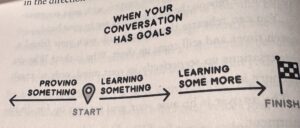
Fisher cites unrealistic goals as things like
- Hoping for an instant apology and an admission of “You were right”
- Expecting them to accept your opinion without question
- Thinking they will concede and fall on the sword of every point you throw out
Realistic goals might be
- Ensuring that the other person knows you care about them
- Gaining a better understanding of where the other person is coming from
- Agreeing on steps to mitigate or eliminate recurrence of the issue
Finally, to help you determine your conversational goal, consider asking yourself questions like
- If I had to choose, what’s the one thing that I need them to understand?
- What small step can I take to show them that I heard them?
- Is there a part of this that I’m trying to win?
I found this advice so simple and helpful. By establishing realistic goals and having a mindset that you’ve got something to learn, will lead to your next conversation being a productive one. Now, I am actually looking forward to getting back with my colleague, and the first thing I want to say is, “I know this project is so important to both of us. I want to be sure I fully understand the direction you’d like to go in. Can we start there?”